
Site Logo Delaware Health and Social Services

    Dhss To Expand Community Well-Being Initiative To Kent County To Help Connect At-Risk Community Members To Substance Use Disorder Services

    WILMINGTON (Sept. 19, 2022) – As a way to directly connect community members struggling with opioid use disorder and other behavioral health issues to treatment, recovery and prevention services, the Community Well-Being Initiative (CWBI), which began in 2021 in high-risk areas of New Castle County, will be expanded to serve targeted neighborhoods in Kent County in collaboration with Delaware State University, Department of Health and Social Services (DHSS) Secretary Molly Magarik announced today at a press conference at the Chase Center.

    “This is about meeting communities where they are and offering on-the-ground support to neighborhood residents who have been significantly impacted by the opioid epidemic in our state,” Secretary Magarik said. “It is important that we are expanding the Community Well-Being Initiative to Kent County to help address the trauma and toxic stress that community members there experience as well. From the success of the New Castle County pilot, we have seen how important it is for Community Well-being Ambassadors to have lived experience and to reside in the areas they serve.”

    The initiative, a partnership between the Department of Health and Social Services’ Division of Substance Abuse and Mental Health (DSAMH) and the University of Delaware’s Partnership for Health Communities, began in 2021 by identifying four ZIP codes in New Castle County– 19801, 19802 and 19805 in Wilmington and 19720 in New Castle– with high rates of fatal and non-fatal overdoses, and high rates of drug arrests. The initiative is funded through the Delaware State Opioid Response (SOR) grant from the U.S. Substance Abuse and Mental Health Services Administration (SAMHSA).

    In the pilot, 24 Community Well-being Ambassadors, who were hired by the nonprofit Network Connect and embedded in the neighborhoods, worked to identify and engage with individuals and families who typically do not seek formal treatment and recovery services for opioid and other substance use disorders. By meeting people where they are, the ambassadors, who work through host sites in the community, were able to build trust with community members. From May 2021 to March 2022, 450 community members engaged with ambassadors, for a total of 2,522 total interactions, including:

    • Engaging people with behavioral health needs when they were ready to engage.
    • Improving coordination across referrals and access to additional social services, including employment, housing and transportation.
    • Providing prevention education and care management for opioid and other substance use disorders, along with support for mental, physical, social and spiritual well-being.
    • Preparing person-centered, peer-supported, long-term treatment support for individuals, families and communities.
    • Building prepared and resilient communities.

    The expansion to Kent County will involve Delaware State University as the managing partner of the initiative, along with DSAMH and UD’s Partnership for Healthy Communities. Additional Kent County partners, include Network Connect, Minds in Motion Integrated Behavioral Health, the Center for Structural Equity/Community Intervention Team, GBA Consulting, and the host sites:

    • Delaware Multi-Cultural Civic Organization
    • DSU Biomedical, Behavioral and Allied Health Center
    • DSU-Downtown
    • Two additional sites (pending)

    “Delaware State University is elated to be a managing partner for such a phenomenal initiative. The Community Well-being Initiative aligns with our university’s core values and mission,”

    said Dr. Gwendolyn Scott-Jones, Dean of DSU’s Wesley College of Health and Behavioral Sciences. “This behavioral health integration and 21st-century case management model of service delivery executed by Network Connect is a monumental approach to addressing health disparities, psychological crises, substance-related disorders, mental health disorders and identifying social determinants that can help us better understand and improve health inequities. More specifically, the partnership with DSAMH, UD, Network Connect and other community partners is a way forward to provide a service integration model that will help people in their environments.”

    “We are grateful to Delaware State University for being the managing partner of the Community Well-being Initiative in Kent County,” said Rita Landgraf, Director of the University of Delaware’s Partnership for Healthy Communities. “The strength of the Community Well-being Initiative is about the diversity of partners coming together, including the communities themselves, to support residents and families who aren’t used to seeking treatment for substance use disorder. The value of promoting health equity is critical to both UD and DSU, as is the experience of being an innovation incubator, piloting new ideas, evaluating how projects work, and learning what will provide that collective impact in our communities.”

    The expansion in Kent County will involve ZIP codes– 19901, 19902, 19904 and 19934– that have high rates of fatal and non-fatal overdoses and high rates of drug arrests. The initiative, which began with Network Connect hiring staff in August 2022, will launch this fall in the communities and be staffed by 16 Community Well-being Ambassadors (CWA) and two CWA Program Coordinators.

    “At DSAMH, we are excited to collaborate with so many community partners, including DSU, to embed ambassadors in these at-risk neighborhoods in Kent County,” said Division of Substance Abuse and Mental Health (DSAMH) Director Joanna Champney. “The Community Well-being Ambassadors have lived experience and provide support directly to community members in their communities. They help individuals and families identify their most pressing needs, provide relevant information, and develop strategies for addressing those needs, including a connection to behavioral health and other community services and ongoing support. Ambassadors also are trained in administering naloxone, a medication that can reverse an opioid overdose, and they distribute naloxone and other critical overdose prevention knowledge in the communities where they work.”

    In the continuing New Castle County pilot, the 24 Community Well-being Ambassadors and two CWA Program Coordinators are embedded in neighborhoods and integrated with these host sites:

    • Center for Structural Equity
    • Game Changers
    • Hilltop Lutheran Neighborhood Center
    • Network Connect
    • Youth Empowerment Center

    Lt. Governor Bethany Hall-Long, Chair of the Behavioral Health Consortium, said the Community Well-being Initiative and the Ambassador program are helping to facilitate two of the Substance Abuse and Mental Health Services Administration’s (SAMHSA) goals under the State Opioid Response grants: to expand opioid use disorder/stimulant use disorder treatment engagement strategies and reduce barriers to accessing treatment, as well as to create a greater strategic focus on racial and ethnic populations in SAMHSA’s investments.

    “As we saw in the targeted outreach in New Castle County and now in the expansion into Kent County, the Community Well-being Initiative is about promoting equity,” Lt. Governor Hall-Long said. “In order to encourage more community residents to seek treatment for substance use disorder, we need to have Community Well-being Ambassadors who live in the communities, collaborating with trusted community partners and building trust with the people they serve. This is another important way that we are building a stronger and healthier Delaware for more of our residents.”

    “Our ambassadors really focus on everyday life skills,” said Cierra Hall-Hipkins, Co-Founder and Co-Executive Director of Network Connect. “They have people come to them with real-life situations that they, too, experienced themselves and they are able to be peer connectors– life coaches, so to speak– for everyday folks in our community. It’s a game-changer.”

    In 2021, Delaware reported 515 overdose deaths, an increase of more than 15% over 2020, according to the Delaware Division of Forensic Science (DFS). In Kent County, overdose deaths increased 74% from 50 in 2020 to 87 in 2021. DFS also reported that 425 of the 515 deaths involved fentanyl, a synthetic pain reliever that is 50-100 times more potent than morphine.

    NOTE TO MEDIA: A group photo from today’s press conference is attached. Here is the caption:

    Community Well-being Ambassadors from Network Connect, a Wilmington nonprofit, join DHSS Secretary Molly Magarik; Division of Substance Abuse and Mental Health Director Joanna Champney; Dr. Gwendolyn Scott-Jones, Dean of Wesley College of Health and Behavioral Sciences at Delaware State University; Cierra Hall-Hipkins, Co-Founder and Co-Executive Director of Network Connect; Orlando Foreman, a Community Well-being Ambassador; and other officials after a Sept. 19 press conference at the Chase Center in Wilmington announcing an expansion of the Community Well-being Initiative into high-risk neighborhoods in the Dover area.

    Delaware Health and Social Services is committed to improving the quality of the lives of Delaware’s citizens by promoting health and well-being, fostering self-sufficiency, and protecting vulnerable populations.
    Division Of Child Support Services Offices Will Be Closed Sept. 23

    NEW CASTLE (Sept. 19, 2022)– Delaware Division of Child Support Services (DCSS) offices in all three counties will be closed Friday, Sept. 23, due to an in-service staff meeting. Child support customers who have in-person business are encouraged to come earlier in the week.

    Account information can be accessed 24/7 by calling the Automated Assistance Line at 302-577-7171 or logging into the customer website. Information about the customer website and how to create a username and password can be found at DCSS’s website.

    Delaware Child Support Services offices will return to regular hours at 8 a.m. Monday, Sept. 26.

    For information about Delaware’s child support program, visit the website or the division’s Facebook page.

    Delaware Health and Social Services is committed to improving the quality of the lives of Delaware’s citizens by promoting health and well-being, fostering self-sufficiency, and protecting vulnerable populations.

    Monthly Covid-19 Update – September 16, 2022:Covid-19 Cases, Hospitalizations Decline In Last Month; DPH Shares Information On Bivalent Boosters

    DOVER, DE (September 16, 2022)– The Delaware Division of Public Health (DPH) is pleased to share declines in hospitalizations, test positivity rates and the 7-day average of new positive COVID-19 cases continued for the second month in a row. Deaths also remain low. However, COVID-19 is still circulating in the community, and at higher levels in some counties. Additionally, while hospitalizations overall are down, in recent weeks they have increased in the 0-4 months age range and the 18-34 years age range. According to the Centers for Disease Control and Prevention’s (CDC) COVID-19 Community Levels data tracker, which was last updated on September 15, COVID-19 community levels in Kent and Sussex counties are considered medium, while levels in New Castle County are listed as low.

    Recently, the Food and Drug Administration (FDA) and CDC have authorized the new bivalent boosters from Pfizer-BioNTech and Moderna, which target two strains of COVID-19: the original strain of the virus, and two of the Omicron variants (BA.4 and BA.5), currently, the most widespread variants in the world. The updated bivalent boosters are available to all individuals 12 years of age and older who have received their primary series of vaccination at least two months before (a minimum of two doses of Pfizer, Moderna or Novavax and one dose of Johnson and Johnson). Individuals who have recently had COVID-19 are still encouraged to get a booster to optimize their protection but should consider waiting three months after they have recovered.

    Changes in the virus necessitated new, updated boosters to improve protection. To reduce confusion among the public and vaccine providers, and because they do not offer the increased levels of protection provided by the bivalent boosters, the original booster formula is no longer authorized for use in those 12 and older. Medical providers may no longer administer them to anyone older than 12.

    By authorizing the vaccines in September rather than waiting until later this fall, the CDC estimates the prevention of over 137,000 hospitalizations and 9,200 deaths in the first two months alone. To further support the effectiveness of vaccines and boosters in reducing serious illness, a study of the Journal of the American Medical Association indicates that during the original Omicron surge earlier this year, unvaccinated individuals were 10.5 times more likely to be hospitalized than those who were vaccinated and boosted.

    Pfizer-BioNTech boosters are authorized for ages 12 and older, while Moderna is authorized for 18 years of age and older. Regardless of which brand of vaccine you previously received, you can get any bivalent booster for which you are eligible. As of this time, only the monovalent boosters targeting the original strain are available for children 5 through 11 years of age. Parents are encouraged to vaccinate their children now with the primary series and most current boosters when eligible until the bivalent boosters are authorized for this age group. With the rise in hospitalizations among those ages 0– 4 years old, parents of young children are particularly encouraged to get their children vaccinated.

    DPH strongly encourages everyone 12 and older to get their bivalent booster as soon as they are eligible, and well in advance of any possible surge in the late fall or winter. Individuals may also get a booster at the same time as they get their annual flu vaccine, but it is recommended to do so in different arms. Bivalent boosters are available at DPH clinics, many pharmacies, Federally Qualified Health Centers and some community events. You can find a list of locations at de.gov/getmyvaccine. or at vaccines.gov. More details on the bivalent booster can be found at de.gov/boosters.

    The webpage also has a link to a flier for the public which highlights some similarities between the labels of bivalent boosters and some primary series vaccines. Those getting a booster are encouraged to print and take a copy of the flier with them, or pull it up on their phone’s web browser, and ask the vaccine provider to show you the vial that your bivalent booster is being drawn from so you can confirm it is the correct one. It is an important step in being an educated health consumer and advocate for your personal health.

    The below data is as reported on Delaware’s My Health Community data portal on Thursday, Sept. 15, 2022.

    COVID-19 Cases and Hospitalizations:

    • Total positive cases since March 11, 2020: 305,517*
    • 7-day daily average of new positive cases: 196.1, a decrease of 83.3 average new positive cases reported since Aug 18, 2022
    • 7-day daily average for the percentage of total positive tests: 12.5 percentage points, a decrease of 5.9 percentage points reported since Aug 18, 2022
    • Hospitalizations: 121 current hospitalizations; critically ill: 14
    • Total COVID-19 deaths: 3,080, an increase of 44 since last month (11 regularly reported, and 33 from a review of Vital Statistics between June and August)

    *Case and testing data are based on reporting of lab-confirmed COVID-19 tests only. The number of COVID-19 cases in the community is higher than what is reported because of the use of at-home test kits.

    COVID-19 Vaccinations:

    • Total number of doses administered in Delaware: 1,893,787
    • Percentage of Delawareans 5+ who are fully vaccinated (CDC data): 75.1%
    • Percentage of Delawareans 12+ who are fully vaccinated (CDC data): 79.2%
    • Percentage of Delawareans 18+ who are fully vaccinated (CDC data): 80.7%
    • Percent of Delawareans who are fully vaccinated (CDC data): 70.9%

    All qualifying Delawareans should get vaccinated. For a location near you, visit de.gov/getmyvaccine.. Delaware’s latest COVID-19 vaccination statistics can be found under the Vaccine Tracker dashboard at de.gov/healtycommunity

    COVID-19 Case Vaccination Status Report:

    The following reports capture a weekly breakdown of non-boosted cases, deaths, and hospitalizations for the time frame of Sep 5– Sep 11, 2022.

    Non-boosted: Case– Hospital– Death

    Weekly Overview

    (09/05/22– 09/11/22)

    # of Non-boosted Cases

    Total Non-boosted

    886

    Total Cases

    1288

    Percent of Non-boosted Cases

    64%

    Non-boosted Hospitalized cases

    # of Cases

    Total Non-boosted Hospitalized Cases

    84

    Total Hospitalized Cases

    136

    Percent of Non-boosted Cases

    61%

    Non-boosted Deaths

    # of Cases

    Total Non-boosted Deaths

    0

    Total COVID-19 Deaths

    1

    Percent of Non-boosted Deaths

    0%

    Note:

    Case and Hospitalization Count: based on RTS (Report to State Date)

    Death: based on DoD (Date of Death)

    Long-term Care Statistics:

    As of Thursday, September 15, 2022, there have been a total of 4,573 positive COVID-19 cases involving long-term care residents, and 979 residents of Delaware long-term care facilities have died from complications related to COVID-19.

    Resources:

    Individuals with general questions about COVID-19 should call Delaware 2-1-1, individuals who are deaf or hard of hearing can text their ZIP code to 898-211, or email delaware211@uwde.org. Hours of operation are:

    • Monday– Friday: 8:00 a.m. to 9:00 p.m.
    • Saturday: 9:00 a.m. to 5:00 p.m.

    Medically related questions regarding testing, symptoms, and health-related guidance can be submitted by email at DPHCall@delaware.gov.

    DPH will continue to update the public as more information becomes available. For the latest on Delaware’s response, go to de.gov/coronavirus.

    Anyone who is deaf, hard of hearing, Deaf-Blind or speech disabled can contact DPH by dialing 711 first using specialized devices (i.e. TTY, TeleBraille, voice devices). The 711 service is free and to learn more about how it works, please visit delawarerelay.com.

    DPH, a division of DHSS, urges Delawareans to make healthier choices with the 5-2-1 Almost None campaign: eat 5 or more fruits and vegetables each day, have no more than 2 hours of recreational screen time each day (includes TV, computer, gaming), get 1 or more hours of physical activity each day, and drink almost no sugary beverages.

    Delaware Health and Social Services is committed to improving the quality of the lives of Delaware’s citizens by promoting health and well-being, fostering self-sufficiency, and protecting vulnerable populations.

    DPH Shares Activities As Part Of Falls Prevention Awareness Week September 18-24, 2022

    DOVER, DE (Sept. 14, 2022)– Falls can result in broken bones, head injuries, and temporary or permanent disabilities, and the Delaware Coalition for Injury Prevention’s Falls Prevention Team says it takes community effort to prevent them. The Injury Prevention Coalition operates under the Division of Public Health’s (DPH) Office of Emergency Medical Services section.

    In recognition of the importance of fall prevention, Governor John Carney and Lt. Governor Bethany Hall-Long proclaimed September 18-24, 2022, as Falls Prevention Awareness Week in keeping with the nationally recognized week.

    “We need to look out for all Delawareans, especially our most vulnerable neighbors,” said Governor Carney. “When everyone focuses on how they can prevent falls, we create safer communities.”

    “Preventing falls is important not only to keep individuals of all ages safe, but also to reduce the strain on the emergency services and health care system,” said Steve Blessing, Chief of DPH’s Office of Emergency Medical Services and Preparedness. “Falls create a ripple effect in the person’s life, the life of their families who may need to arrange for a higher level of care for them, and the EMS and medical system as a whole.”

    On Sept. 20, the Falls Prevention Team and the Modern Maturity Center (MMC) will show the movie “Denying Gravity.” The movie highlights in a relatable, good-humored approach the positive effects of fall prevention activities for seniors. A small health fair with information on preventing falls precedes the movie. The event is free and open to the public. It runs from 11:00 a.m. to 1:00 p.m. at the MMC, located at 1121 Forrest Avenue in Dover, Delaware. Registration is not required. Should movie-goers choose to stay for lunch in the Longwood Dining Room, the cost is $6.00 for ages 60 and older and $9.00 for ages up to 59. Visit www.modern-maturity.org/ for more information.

    Falls occur among persons of all ages, though in the United States young children and seniors are most at risk for suffering fall-related traumatic brain injuries. Traumatic brain injuries lead to major life changes for the individual and their families. In the U.S., falls are the leading cause of trauma-related hospitalizations among adults aged 65 and older, with one in four in that age group falling every year, according to the Centers for Disease Control and Prevention (CDC). According to the Delaware Trauma Registry, 3,229 individuals were injured from falls and seen at a Delaware trauma center in 2021. Of that total, 1,833 were over the age of 64 and survived the fall while 38 people in that age group died.

    “Head injury and hip fractures are unfortunately common among seniors who fall, and that impacts their mobility long-term,” said Lt. Governor Hall-Long who is also a Registered Nurse. “It is so important for them to improve their balance and strengthen leg muscles, which can weaken from inactivity.”

    The Falls Prevention Team asks communities, businesses, schools, organizations, and households to follow this safety advice to prevent falls:

    • Adults, especially seniors and individuals using wheelchairs and walkers, can get regular vision and hearing checkups and visit their health care provider to review medications, balance and coordination, muscle strength, and physical activity level. Adults should eat nutritious foods and beverages, stay hydrated, exercise regularly, and get appropriate sleep.
    • Wear shoes in good condition without worn soles and heels. Shoes should fit well and not fall off the feet. Individuals at risk of falls should wear shoes and slippers that fit around their feet with no open backs.
    • Ensure proper fit of canes and walkers.
    • Do not let pets get underfoot. Teach them basic commands like “sit” and “stay.”
    • Use motion-activated lights to keep walkways and parking areas well lit. Use motion-activated night lights inside.
    • Keep homes, yards, and public areas free of clutter.
    • Maintain walkways to ensure a smooth surface without crumbling or splintered surfaces. Prevent slippery conditions by removing snow, ice, rain, wet moss, leaves, oil, and other substances that can cause individuals to fall.
    • Ensure that there are curb cuts or other detectable warning surfaces that meet state/local safety codes and the guidelines provided by the Americans with Disabilities Act. Curb cuts, tactile surface pavers, slopes, contrasting colors, and other universal design elements benefit everyone, especially individuals with disabilities who use walkers and wheelchairs, those pushing strollers, and those who cannot see well or easily lift their feet up onto the curb.
    • Install handrails, ramps, and automatic doors and keep them free of hazards.
    • Use entrance mats with flat and secured edges that do not curl up. Absorbent floor mats catch rain and snow at entrances and spilled drinks at food establishments.

    To improve coordination and balance, older Delawareans can enroll in A Matter of Balance© classes that are held in communities throughout the state. For a schedule of A Matter of Balance© classes, call Volunteer Delaware 50+ at 302-515-3020.

    ChristianaCare offers BingoCize, an evidence-based fall prevention program integrating Bingo and exercise, as well as the ThinkFirst to Prevent Falls© program, which can be done either virtually or in person. The ThinkFirst program addresses home modifications, medications, balance, healthy eating, and other strategies to prevent falls. To schedule these programs and obtain more information, send an email to injuryprevention@christianacare.org.

    To learn more about falls and falls prevention, refer to the CDC’s Stopping Elderly Accidents, Deaths, and Injuries (STEADI) program at https://www.cdc.gov/steadi/index.html and the National Council on Aging at https://www.ncoa.org/. For falls data, visit the Delaware Trauma System Registry webpage at https://dhss.delaware.gov/DPH/ems/trauma.html.

    Proclamation in Observance of Falls Prevention Awareness Week

    Anyone who is deaf, hard of hearing, Deaf-Blind or speech disabled can contact DPH by dialing 711 first using specialized devices (i.e. TTY, TeleBraille, voice devices). The 711 service is free and to learn more about how it works, please visit delawarerelay.com.

    DPH, a division of DHSS, urges Delawareans to make healthier choices with the 5-2-1 Almost None campaign: eat 5 or more fruits and vegetables each day, have no more than 2 hours of recreational screen time each day (includes TV, computer, gaming), get 1 or more hours of physical activity each day, and drink almost no sugary beverages.

    Delaware Health and Social Services is committed to improving the quality of the lives of Delaware’s citizens by promoting health and well-being, fostering self-sufficiency, and protecting vulnerable populations.

    DPH Announces Updates To Monkeypox Cases, Vaccine Access And Launch Of Public Health Alert Web Portal

    DOVER, DE (Sept. 1, 2022) – The Delaware Division of Public Health (DPH) is announcing several Monkypox virus (MPX) updates including the launch of a Public Health Alert web portal providing access to an updated monkeypox web page. The website, which can be found at de.gov/PublicHealthAlerts, was created by the Department of State’s Government Information Center and is a central landing page from which to access individual web pages for COVID-19, MPX and flu. It is intended to highlight public health issues of elevated concern at the time.

    The updated MPX page, which can still be found at de.gov/monkeypox, provides information on the disease in a more user-friendly format. (COVID-19 information can also continue to be found at de.gov/coronavirus, and flu information at flu.delaware.gov). The updated MPX site includes a separate section for medical providers seeking information and highlights the most current data related to cases. Delaware now has 25 total MPX cases in the state, which remains low compared to neighboring states which have hundreds. DPH will no longer issue press releases solely for case updates, as the data will be more frequently updated on the webpage. Delaware is taking action to continue to ensure the most at-risk persons are vaccinated against the virus.

    Starting Sept. 5, DPH will expand access to the MPX vaccine to those who are immunocompromised. Conditions may include, but are not necessarily limited to: those with cancer, solid organ or stem cell transplants, those taking immunosuppressive therapy, and individuals with autoimmune disease.

    Additionally, DPH is pleased to announce that starting today, Newark Urgent Care began administering MPX vaccine to eligible individuals. Vaccination is available by appointment only; visit NewarkUrgentCare.org to view eligibility requirements and schedule an appointment. Vaccine clinics will be held on Thursdays and there is no cost for the vaccine.

    Eligible persons also can be vaccinated at the following locations:

    • Beebe Healthcare: Individuals can schedule an appointment at beebehealthcare.org/online-scheduling. Walk-ins will not be accepted.
    • DPH clinics: Individuals should call the MPX hotline at 866-408-1899 for a screening evaluation. Walk-ins at DPH clinics will not be accepted.
    • Monkeypox vaccinations at DPH clinics will continue to prioritize individuals at highest risk after a DPH evaluation: persons known or presumed to be exposed to someone with MPX in the last 14 days, and certain individuals who have sex with men and who have had multiple sex partners within the past 14 days. As a result, appointments may need to be scheduled a few days out.

    Vaccines are available to those confirmed to have been exposed, or who are at higher risk of being exposed to the virus, as well as the immunocompromised, and those engaging in high-risk activities, including sexual practices, that increase exposure to MPX, such as:

    • Gay, bisexual, and other men who have sex with men and have had multiple, or any, anonymous sexual partners in a social network experiencing monkeypox activity, this includes meeting partners through an online website, digital application (“app”), or social event (e.g., a bar or party)
    • Transgender women or nonbinary persons assigned male at birth who have sex with men
    • Sex workers (of any sexual orientation/gender)
    • Staff (of any sexual orientation/gender) at establishments where sexual activity occurs (e.g., bathhouses, saunas, sex clubs)”¯
    • Eligibility may be determined by the vaccinating provider and may include (but are not necessarily limited to): those with cancer, solid organ or stem cell transplants, those taking immunosuppressive therapy, and individuals with autoimmune disease.

    Individuals should be aware that the vaccine, a two-dose series given 28 days apart, is not considered effective until two weeks after the second dose. Those at higher risk should continue to use preventive measures and reduce engaging in any high-risk behaviors until that time.

    Signs and Symptoms

    The symptoms of MPX are similar to but milder than the symptoms of smallpox. Symptoms usually start within three weeks of exposure to the virus. Most people who contract MPX will develop a rash, and some will develop flu-like symptoms beforehand. The flu-like symptoms may include fever, headache, muscle aches and backache, sore throat, cough, swollen lymph nodes, chills, or exhaustion. If someone has flu-like symptoms, they usually will develop a rash one to four days later.

    If you suspect you are experiencing any symptoms associated with MPX you should immediately:

    • Contact your health care provider and discuss your symptoms and concerns.
    • Self-isolate until all lesions have resolved, the scabs have fallen off, and a fresh layer of intact skin has formed.
    • Avoid being intimate with others.
    • Make a list of your close and intimate contacts in the last 21 days.

    Currently, while there is no specific treatment for MPX, antivirals can be prescribed, though they are not always needed. To learn more information about monkeypox, please visit de.gov/monkeypox. DPH began posting MPX case and vaccine data on the website last week.

    DPH launched a hotline for individuals with questions or concerns about MPX. The hotline number is 866-408-1899 and is operational Monday– Friday from 8:30 a.m. to 4:30 p.m. (It will be closed this Monday because of the Labor Day holiday.) Questions may also be emailed to DPHCall@delaware.gov. Both the hotline number and email address share staff with the COVID-19 Call Center. To learn more about MPX prevention programs and resources, visit de.gov/monkeypox.

    The Delaware Division of Public Health (DPH), a division of the Delaware Department of Health and Social Services, is a nationally accredited public health agency recognized by the Public Health Accreditation Board for its outstanding dedication to driving change through innovation. DPH is committed to improving the quality of the lives of Delaware’s citizens by promoting health and well-being, fostering self-sufficiency, and protecting vulnerable populations.

    Anyone who is deaf, hard of hearing, Deaf-Blind, or speech-disabled can contact DPH by first dialing 711 using specialized devices (i.e., TTY, TeleBraille, voice devices). The 711 service is free; to learn more about how it works, visit delawarerelay.com.

    Delaware Health and Social Services is committed to improving the quality of the lives of Delaware’s citizens by promoting health and well-being, fostering self-sufficiency, and protecting vulnerable populations.

    Fda Authorizes Bivalent Covid-19 Boosters; Cdc Sign-Off Expected By This Weekend, With First Doses Being Administered As Early As Next Week

    DOVER, DE (August 31, 2022)– On Aug. 31, the U.S. Food and Drug Administration (FDA) granted Emergency Use Authorization to Pfizer and Moderna for their new bivalent boosters, meaning vaccine could start shipping to states that pre-ordered as early as Friday. The Centers for Disease Control and Prevention’s (CDC) advisory committee meets Thursday and Friday, Sept. 1 and 2, to discuss specifics regarding who should receive the boosters. The committee is expected to vote during that time, and if approved, a formal sign-off is then required from the CDC director before vaccine administration can begin.

    The Division of Public Health (DPH) has preordered approximately 17,000 doses of the bivalent boosters for DPH clinics and enrolled medical providers, in addition to the supply being sent directly to pharmacies and Federally Qualified Health Centers. Delivery is expected later this week or early next week with administration potentially beginning soon after Labor Day or the following week.

    The Moderna and Pfizer bivalent boosters both target two strains of COVID-19– the original strain of the virus and two of the Omicron variants (BA.4 and BA.5), the current most widespread variants in the world. Only individuals who have completed their primary vaccination series (two doses of Pfizer or Moderna or one dose of Johnson & Johnson) are eligible to receive the bivalent booster. Those who have recently received Novovax are not yet eligible for any booster at this time.

    “Should the CDC Advisory Committee and the CDC Director sign off on authorizing the use of bivalent boosters, this will be another important step forward in keeping Delawareans protected against serious outcomes from COVID-19,” said DPH Interim Director Dr. Rick Hong. “Delaware providers are well-positioned to begin administering the bivalent booster within a few days of the final approval being given.”

    If you have not been vaccinated or have not completed your primary series, visit de.gov/getmyvaccine for a list of locations offering vaccine. The original formulations of Pfizer, Moderna, J&J and Novovax will continue to be used. Booster doses use reduced amounts of the original vaccines.

    Individuals are eligible for the bivalent booster two months since their last primary or booster dose of any vaccine. As of today, the current monovalent booster will not be available to persons 12 and older; the FDA is removing authorization for those boosters to reduce provider confusion for staff administering vaccines.

    The Pfizer bivalent booster is currently authorized for ages 12 and older while Moderna’s is currently authorized for 18 years of age and older. Individuals may choose to receive either the Pfizer or Moderna bivalent booster, regardless of which primary series vaccine or original booster dose they had previously.

    Authorization for administration to those under age 12 is expected in the near future, but the timeline is not yet clear. Parents are encouraged to have their children complete the primary series of the current vaccines so that they will be eligible for the bivalent booster in the future. In August, while there was a decrease in COVID-related hospitalizations for most adult age groups, hospitalizations for all youth age groups increased, demonstrating the importance of young children becoming fully vaccinated as soon as possible to prevent serious illness, hospitalization, and death. As such, parents of children under 12 should consider having them receive the original booster at this time to increase their defenses against the virus with back to school and other group activities now occurring.

    For the latest information on bivalent boosters, visit de.gov/boosters. When locations begin administering the bivalent booster, updated information will be available at de.gov/getmyvaccine on how and where to obtain a booster. Information on all things COVID-19 can be found at the DPH website de.gov/coronavirus. COVID-19 data for Delaware is available at https://myhealthycommunity.dhss.delaware.gov/locations/state.

    Anyone who is deaf, hard of hearing, Deaf-Blind or speech disabled can contact DPH by dialing 711 first using specialized devices (i.e. TTY, TeleBraille, voice devices). The 711 service is free and to learn more about how it works, please visit delawarerelay.com.

    DPH, a division of DHSS, urges Delawareans to make healthier choices with the 5-2-1 Almost None campaign: eat 5 or more fruits and vegetables each day, have no more than 2 hours of recreational screen time each day (includes TV, computer, gaming), get 1 or more hours of physical activity each day, and drink almost no sugary beverages.

    Delaware Health and Social Services is committed to improving the quality of the lives of Delaware’s citizens by promoting health and well-being, fostering self-sufficiency, and protecting vulnerable populations.

    DPH Announces First Human Case Of West Nile Virus Of The Year In Sussex County Man

    DOVER, DE (Aug. 31, 2022)– The Division of Public Health (DPH) is announcing this year’s first human case of West Nile Virus (WNV), in a 78-year-old Sussex County man. West Nile Virus is a mosquito-borne illness that can cause serious health problems.

    In addition to the first human WNV case, there also have been confirmed cases in a horse in New Castle County, and in 19 sentinel chickens in outdoor-caged and humanely tended stations maintained throughout the state by the Department of Natural Resources and Environmental Control (DNREC). Delawareans should be aware that mosquitoes that cause WNV bite primarily during the evening and morning hours; or dusk and dawn. However, mosquitoes that cause other diseases such as chikungunya, dengue fever, and Zika can bite during the day. It is important to protect yourself by wearing insect repellent whenever you go outdoors.

    WNV is transmitted by mosquitoes, generally in summer and fall, with a peak period for disease transmission from mid-August to mid-October. Nearly 80 percent of people infected with WNV will not become ill. Less than 20 percent of those infected with the virus will develop mild symptoms such as fever, headache, body aches, a skin rash on the chest or back, and swollen lymph glands. Approximately one in 150 people infected will develop severe infection which may include headache, high fever, stiff neck, tremors or convulsions, muscle weakness, encephalitis or meningitis, all possibly leading to hospitalization and very rarely death. The elderly and those with weakened immune systems are most at risk to contract WNV from mosquitoes. Anyone who experiences any of these severe symptoms should immediately seek medical assistance.

    To avoid mosquito bites and reduce the risk of infection, individuals should:

    • Use Environmental Protection Agency (EPA)-registered insect repellents. Follow the manufacturer’s instructions for reapplication times.
    • If using sunscreen, apply it first and insect repellent second.
    • Adults taking precaution with children against biting mosquitoes should spray insect repellent onto their hands and then apply it to the child’s face. Do not apply insect repellent onto a child’s hands, eyes, mouth, or on cuts or irritated skin.
    • Do not use insect repellent on babies younger than two months of age.
    • When outside during periods of mosquito activity, wear light-colored long-sleeved shirts and long pants.
    • Dress children in clothing that covers arms and legs.
    • Consider using mosquito netting, which offers protection to the face and neck and also protects infants in carriages, strollers and playpens.
    • Use permethrin (an insecticide) to treat clothing and gear (such as boots, pants, socks, and tents), but do not apply to the skin.
    • Prevent mosquitoes from entering the house by using screens and tightly sealed windows and doorways.

    DNREC’s Mosquito Control section announced WNV in sentinel chickens for the first time in July 2021. Mosquito-transmitted virus detections in DNREC’s sentinel chickens are unrelated to Delaware’s poultry industry. The possibility of contracting mosquito-transmitted diseases, including WNV and Eastern Equine Encephalitis (EEE), will continue until colder autumn temperatures in mid-October or later.

    • To report suspected cases of human WNV, call the DPH Office of Infectious Disease Epidemiology at 1-888-295-5156.
    • For more information about mosquitoes and mosquito-borne illnesses, use the following resources:
      • For mosquito biology/ecology and control, contact the DNREC Mosquito Control section office in Dover at 302-739-9917.
      • For requests for mosquito relief in upstate areas from Dover north, contact Mosquito Control’s Glasgow field office at 302-836-2555.
      • For requests for mosquito relief in downstate areas south of Dover, contact Mosquito Control’s Milford field office at 302-422-1512.
    • Contact the Delaware Department of Agriculture’s Poultry and Animal Health Section for animal health questions at 302-698-4500.
    • To report suspected cases of human WNV, call the DPH Office of Infectious Disease Epidemiology toll-free at 1-888-295-5156.

    For more information on West Nile Virus or Eastern Equine Encephalitis, visit https://dhss.delaware.gov/DPH/epi/wnv.html.

    For more information on what you can do to prevent West Nile Virus, visit the Centers For Disease Control and Prevention’s website, www.cdc.gov/westnile/prevention/index.html.

    Anyone who is deaf, hard of hearing, Deaf-Blind or speech disabled can contact DPH by dialing 711 first using specialized devices (i.e. TTY, TeleBraille, voice devices). The 711 service is free and to learn more about how it works, please visit delawarerelay.com.

    DPH, a division of DHSS, urges Delawareans to make healthier choices with the 5-2-1 Almost None campaign: eat 5 or more fruits and vegetables each day, have no more than 2 hours of recreational screen time each day (includes TV, computer, gaming), get 1 or more hours of physical activity each day, and drink almost no sugary beverages.

    About DNREC

    The Delaware Department of Natural Resources and Environmental Control protects and manages the state’s natural resources, protects public health, provides outdoor recreational opportunities, and educates Delawareans about the environment. The DNREC Division of Fish and Wildlife conserves and manages Delaware’s fish and wildlife and their habitats, and provides fishing, hunting, wildlife viewing and boating access on nearly 68,000 acres of public land. For more information, visit the website and connect with @DelawareDNREC on Facebook, Twitter or LinkedIn.

    Media contacts: Michael Globetti, Joanna Wilson

    Delaware Health and Social Services is committed to improving the quality of the lives of Delaware’s citizens by promoting health and well-being, fostering self-sufficiency, and protecting vulnerable populations.

    Delaware Division Of Public Health Re-Accredited As Nationally Accredited Public Health Agency

    DOVER, DE (Aug 31, 2022)– The Delaware Division of Public Health (DPH) is announcing that it has been re-accredited by the national Public Health Accreditation Board (PHAB). The Board formally issued Delaware’s continued accreditation status on Aug. 18. In maintaining its accreditation status for another five years, DPH has demonstrated that it meets PHAB’s quality standards and measures. Delaware is among only 22 percent of the accredited public health departments in the country to earn continued accreditation this year.

    “After 21/2 years of the COVID-19 pandemic, Delawareans have learned how important it is to have a strong public health response in our state,” said Department of Health and Social Services (DHSS) Secretary Molly Magarik. “I am grateful to the Public Health Accreditation Board for this re-accreditation, but I am especially grateful to the employees of the Division of Public Health for the work they have done and continue to do during the pandemic, and the work they do every day to evolve, improve and advance the health of Delawareans. This is another way we are building a healthier and stronger Delaware.”

    PHAB’s accreditation program, which receives support from the Centers for Disease Control and Prevention (CDC) and the Robert Wood Johnson Foundation, sets standards against which the nation’s governmental public health departments can continuously improve the quality of their services and performance.

    “I am very pleased that DPH has been re-accredited as a Nationally Accredited Public Health agency,” said DPH Interim Director Dr. Rick Hong. “During the August 2022 site visit, the PHAB accreditation team particularly praised our policies, procedures, and programs; comprehensive Performance Management system; and efforts to create a culture of evidence-based public health practice and partnership building. Much of the credit goes to the high-performance of our DPH employees. By improving our services and performance, we can be sure we are meeting the public health needs of those we serve as effectively as possible.”

    Dr. Hong also expressed gratitude to outgoing Associate Deputy Director, Cassandra Codes-Johnson, and Office of Performance Management Director Matthew Whitman for their dedication and tireless work in spearheading the re-accreditation process. Additionally, he recognized the work of former DPH Director Dr. Karyl Rattay in building a strong foundation within the Division which led to DPH’s initial accreditation in June 2016. The press release announcement for this milestone can be found here: https://www.dhss.delaware.gov/pressreleases/2016/dphaccreditation-060816.html.

    The CDC identifies accreditation as a critical strategy for strengthening public health infrastructure. To acquire continued accreditation, DPH had to demonstrate how it implements public health services in Delaware, through policies, procedures, practices, programs, and community partnerships. DPH demonstrated success in each of these areas while successfully managing the state’s response to a worldwide pandemic.

    “We are extremely pleased to be at the point in the accreditation program where the Delaware Division of Public Health, along with many others, are successfully maintaining their five-year accreditation status through PHAB,” said PHAB President and CEO Paul Kuehnert, DNP, RN, FAAN. “In so doing, these health departments are assuring their communities that the value of accreditation is long-term — not a one-time recognition — and that continual improvement is the hallmark of a 21st-century organization.” The national accreditation program began in 2011.

    Often called the “backbone” of the public health system, public health departments are on the front lines of communities’ efforts to protect and promote health and prevent disease and injury. PHAB-accredited health departments demonstrate great leadership by placing their work for peer review, with the goal of using the feedback obtained during the process to improve the services they provide to their communities.

    Anyone who is deaf, hard of hearing, Deaf-Blind or speech disabled can contact DPH by dialing 711 first using specialized devices (i.e. TTY, TeleBraille, voice devices). The 711 service is free and to learn more about how it works, please visit delawarerelay.com.

    DPH, a division of DHSS, urges Delawareans to make healthier choices with the 5-2-1 Almost None campaign: eat 5 or more fruits and vegetables each day, have no more than 2 hours of recreational screen time each day (includes TV, computer, gaming), get 1 or more hours of physical activity each day, and drink almost no sugary beverages.

    About the Public Health Accreditation Board

    The Public Health Accreditation Board (PHAB) was created to serve as the national public health accrediting body and is jointly funded by the Centers for Disease Control and Prevention and the Robert Wood Johnson Foundation. The development of national public health department accreditation has involved, and is supported by, public health leaders and practitioners from the national, state, local, Tribal, and territorial levels. For more information, contact PHAB Communications Manager Janalle Goosby at jgoosby@phaboard.org. Learn more about PHAB and accreditation at www.phaboard.org, and by signing up for the PHAB e-newsletter.

    Delaware Health and Social Services is committed to improving the quality of the lives of Delaware’s citizens by promoting health and well-being, fostering self-sufficiency, and protecting vulnerable populations.

    Division Of Public Health Releases Information On 2020 Delaware Unintentional Drug Overdose Deaths

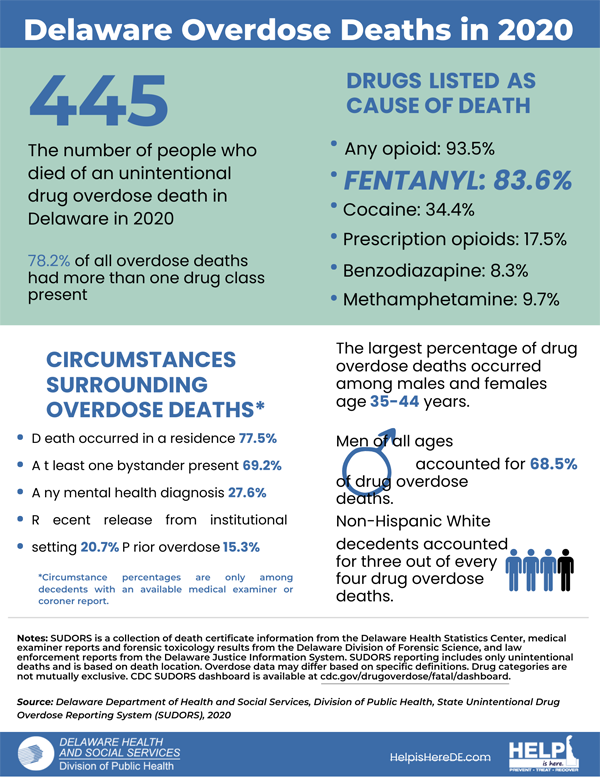
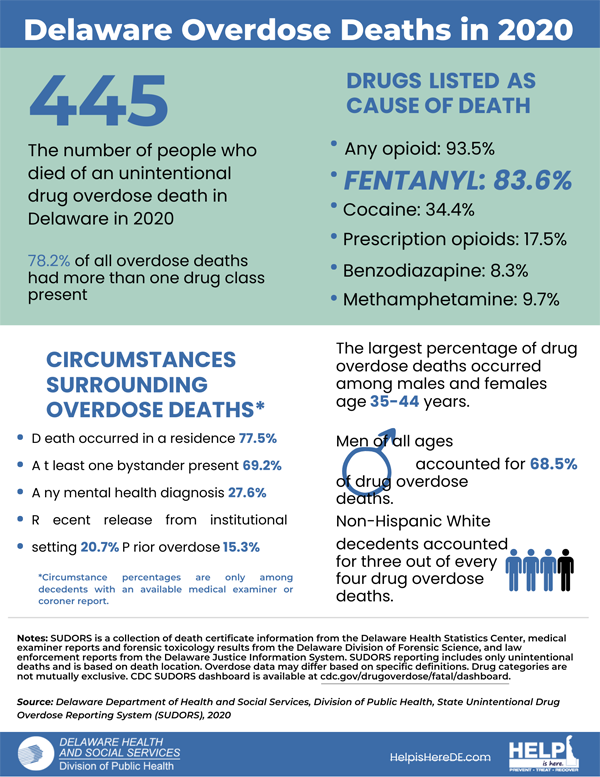
    DOVER, DE (August 30, 2022)– The Division of Public Health (DPH) is releasing a 2020 State Unintentional Drug Overdose Reporting System (SUDORS) fact sheet on all drug overdose deaths that occurred in Delaware. This snapshot contains fatality data abstracted from the state’s Overdose Data to Action (OD2A) collaborative. DPH collects and analyzes unintentional drug overdose death data from death certificate information, medical examiner reports, forensic toxicology results, and law enforcement reports.

    The fact sheet provides information on the drugs listed as the cause of death on the death certificate and drugs identified as present by toxicology or medical examiner reporting. Almost all heroin overdose deaths had fentanyl present (99%). Furthermore, fentanyl was the drug most frequently listed as the cause of death (84%). Most overdose deaths had more than one drug present (78%) and (84%) of all cocaine overdose deaths had fentanyl. Similarly, fentanyl presence is high among methamphetamine (79%) and benzodiazepine (79%) overdose deaths.

    “As we commemorate International Overdose Awareness Day on August 31 and remember the lives lost to overdose, it is important for all Delawareans and visitors to the state to know that no illicit drug is safe,” said DPH Interim Director Dr. Rick Hong. “Assume that drugs not prescribed by your doctor contain, or are laced with, fentanyl. The information analyzed by the Overdose Data to Action collaborative clearly shows that fentanyl is present in not only opioids, but also cocaine, and counterfeit prescription medications.”

    DPH is finalizing its strategy to distribute fentanyl test strips in bulk. Currently, the public can receive two test strips in any DPH Narcan kit, which are available through mail order and at points of distribution (POD) events listed on HelpisHereDE.com. To prevent overdose death, in addition to having Narcan on hand and utilizing fentanyl test strips, a person in active substance use should never use alone and go slow so that someone they trust can monitor them for any adverse side effects.

    To prevent the spread of infectious diseases, DPH encourages persons with substance use disorder (SUD) to engage with Brandywine Counseling & Community Services for more information and syringe exchange services by visiting BrandywineCounseling.com or calling 302-656-2348.

    DPH encourages those struggling with SUD to visit HelpIsHereDE.com to connect to treatment online, in person, or by phone.

    Friends and family need to recognize the signs and symptoms of a SUD. It is also important that parents, educators, counselors, and other influential members recognize the seriousness of fentanyl and have conversations about the risk of overdose when experimenting with drugs.

    If you or a loved one is struggling with addiction in Delaware, call the DHSS 24/7 Crisis Hotline to be connected to treatment and recovery options. In New Castle County, call 1-800-652-2929. Or in Kent and Sussex counties, call 1-800-345-6785.

    For free 24/7 counseling, coaching, and support, as well as links to mental health, addiction, and crisis services call the Delaware Hope Line at 833-9-HOPEDE. To search for treatment and recovery services in Delaware or nearby states, visit HelpIsHereDE.com.

    Anyone who is deaf, hard of hearing, Deaf-Blind or speech disabled can contact DPH by dialing 711 first using specialized devices (i.e. TTY, TeleBraille, voice devices). The 711 service is free and to learn more about how it works, please visit delawarerelay.com.

    DPH, a division of DHSS, urges Delawareans to make healthier choices with the 5-2-1 Almost None campaign: eat 5 or more fruits and vegetables each day, have no more than 2 hours of recreational screen time each day (includes TV, computer, gaming), get 1 or more hours of physical activity each day, and drink almost no sugary beverages.

    Overdose deaths.

    Delaware Health and Social Services is committed to improving the quality of the lives of Delaware’s citizens by promoting health and well-being, fostering self-sufficiency, and protecting vulnerable populations.

    Delaware Division Of Public Health Launches New Fentanyl Test Strip Distribution

    DOVER, DE (Aug. 29, 2022)– The Delaware Division of Public Health’s (DPH) Office of Health Crisis Response (OHCR) is announcing it will begin including fentanyl test strips in Narcan kits it distributes to the public. The effort is part of a harm-reduction strategy aimed at preventing accidental overdoses due to fentanyl consumption.

    Fentanyl is now the leading cause of drug overdose deaths in Delaware, found in more than 80% of fatal overdoses. According to Division of Forensic Science (DFS) data, there were 515 overdose deaths in Delaware in 2021, an increase of 15% from 2020. Fentanyl was found in 83% of those deaths. Individuals can test marijuana, cocaine, meth, ecstasy, and other substances for the presence of fentanyl. The test strips are highly sensitive and will detect fentanyl down to 0.1 mcg/ml. Most overdoses are unintentional, and individuals using may not realize the strength of the drug they are using or that it contains fentanyl. Fentanyl is unable to be detected by sight, taste, smell, or touch.

    “Including fentanyl test strips in Narcan kits, is part of a comprehensive strategy to reduce overdose deaths in the state,” said DPH Interim Director Dr. Rick Hong. “The test strips are a preventive measure. After a test strip detects fentanyl, an individual can choose not to use the drug based on the risk. However, if they choose to use, they can implement alternative harm-reduction strategies, like going slow, not using as much, or/and not using alone. Having Narcan in the same kit empowers family, friends, and neighbors to act in the event of an overdose. Those living with substance use disorder should designate someone trained in using Narcan to check on them. We will continue to discourage drug use and encourage people to seek treatment, but for persons with substance use disorder, we are using a compassionate approach to help raise awareness and empower friends and family to act in an emergency situation.”

    In Delaware, testing strips were considered paraphernalia unless used for clinical purposes until June 3, 2021, when Senate Bill 76 was signed by Governor John Carney, which allows for distribution of fentanyl test strips to be used by lay individuals and organizations. Just prior to that, the Centers for Disease Control and Prevention announced in April 2021, that they would permit state purchases of fentanyl test strips with Overdose Data to Action (OD2A) funding for the purpose of distributing to the public. OD2A supports jurisdictions in collecting high quality, comprehensive, and timely data on nonfatal and fatal overdoses and in using those data to inform prevention and response efforts. DPH is one of sixty-six jurisdictions that joined the OD2A cooperative agreement that focuses on surveillance and prevention strategies.

    Fentanyl test strips are legal in Delaware, though laws may vary in other states. DPH also distributes 10-pack fentanyl test strip kits through a free mail-order program; details can be found at helpisherede.com/understanding-addiction/what-is-fentanyl.

    To further enhance overdose prevention and education efforts, overdose response training is recommended for anyone who has a prescription opioid or knows of someone that has or is using illicit drugs. After the quick training, the individual will receive the overdose reversal medication, Narcan. For community training offerings and information on where you can get free Narcan, go to: https://www.helpisherede.com/overdose-prevention

    If you or a loved one is struggling with addiction in Delaware, call DHSS’ 24/7 Crisis Hotline to be connected to treatment and recovery options. In New Castle County, call 1-800-652-2929. Or in Kent and Sussex counties, call 1-800-345-6785. For free 24/7 counseling, coaching, and support, as well as links to mental health, addiction, and crisis services call the Delaware Hope Line at 1-833-9-HOPEDE. To search online for treatment and recovery services in Delaware or nearby states, visit HelpIsHereDE.com.

    Delaware Health and Social Services is committed to improving the quality of the lives of Delaware’s citizens by promoting health and well-being, fostering self-sufficiency, and protecting vulnerable populations.