



Delaware Health Alert Network #306
June 24, 2013 12:18 pm
Health
Alert
DPH FORWARDING CDC HEALTH ADVISORY REGARDING RECOMMENDATIONS FOR LABORATORY TESTING FOR ACETYL
FENTANYL AND PATIENT EVALUATION AND TREATMENT FOR OVERDOSE WITH SYNTHETIC OPIOIDS
FORWARDED FROM THE CDC BY THE DE DIVISION OF PUBLIC HEALTH
This is an official
CDC HEALTH ADVISORY
Recommendations for Laboratory Testing for Acetyl Fentanyl and
Patient Evaluation and Treatment for Overdose with Synthetic Opioids
Summary:
Recently, a number of intravenous drug users have overdosed on a new, non-prescription injected synthetic opioid, acetyl fentanyl.
Acetyl fentanyl is a fentanyl analog previously undocumented in illicit drug use that is up to five times more potent than heroin. CDC
recommends increased vigilance by public health agencies, emergency departments, state laboratories, medical examiners, and coroners for
patients with symptoms consistent with opioid overdose and laboratory results showing an enzyme-linked immunosorbent assay (ELISA)
positive for fentanyl.
CDC also recommends that public health officials work with laboratories to carry out ELISA screens for fentanyl, and if the results
of these screens are positive for fentanyl, conduct gas chromatography-mass spectrometry (GC/MS) confirmatory testing on specimens to
confirm or rule out fentanyl and its analogs, including acetyl fentanyl.
Background:
Since March 6, 2013, 14 overdose deaths related to a novel, injected non-prescription synthetic opioid have occurred among intravenous
drug users in Rhode Island. Ten of those deaths occurred in March. On May 30, 2013, Rhode Island Department of Health confirmed that the
implicated synthetic opioid is acetyl fentanyl, a fentanyl analog previously undocumented in illicit drug use. Acetyl fentanyl is not
available as a prescription drug in the U.S.
The age of the persons who died from an acetyl fentanyl overdose ranged from 19 – 57 years, and 10 of the decedents were male. The
toxicology testing results for most of the decedents showed, in addition to acetyl fentanyl, varying mixtures of drugs, including
cocaine, heroin (morphine), ethanol, and benzodiazepines. However, none of these additional substances were present in all decedents and
none of these persons tested positive for fentanyl by GC/MS after testing positive for fentanyl by ELISA. Toxicology results for one
decedent showed only acetyl fentanyl (by GC/MS) and no other substances. These deaths represent a significant increase in the number of
illicit drug overdose deaths compared with the number of cases typically reported in one month in Rhode Island.
There have been unconfirmed reports from other states of increases in illicit opioid-related overdose events seen in emergency
departments. Media stories have associated these events with “fentanyl-contaminated heroin” or, in some cases, to fentanyl
alone. It is possible that these events are related to acetyl fentanyl, but confirmatory testing is needed. States other than Rhode
Island have not informed CDC that they are testing for acetyl fentanyl.
Case definitions:
- Illicit opioid-related overdose: A diagnosis by a physician of illicit opioid overdose.
Note: If a suspected illicit opioid overdose event results in death, jurisdictions often carry out drug screening. Some jurisdictions
perform an ELISA that includes a screen for fentanyl, while others do not routinely screen for fentanyl. CDC recommends screening for
fentanyl by ELISA to improve the detection of fentanyl-related overdose deaths.
- Suspected fentanyl overdose death: An overdose death in a person who tests positive for fentanyl by ELISA screen.
Note: Some jurisdictions routinely screen for fentanyl, but do not perform confirmatory GC/MS testing. If the ELISA screen is positive
for fentanyl and GC/MS confirmatory testing does not take place, an overdose death may be incorrectly attributed to fentanyl. CDC
strongly encourages confirmatory GC/MS testing to determine if suspected fentanyl overdose deaths are caused by fentanyl, acetyl
fentanyl, or another fentanyl analog (see case definition 3 below).
- Acetyl fentanyl overdose death: An acetyl fentanyl overdose death in a person who initially tests positive for fentanyl by
ELISA assay, but upon confirmatory GC/MS testing, tests positive for acetyl fentanyl rather than fentanyl. In these cases, the GC/MS
results show a distinct chromatographic peak with a mass spectrum consistent with acetyl fentanyl or 4-Anilino-n-phenethylpiperdine
(ANPP – a compound believed to be a precursor of acetyl fentanyl).
Recommendations:
Health care and clinical recommendations:
Because of these reports of increases in illicit opioid-related overdose events, CDC encourages emergency departments and emergency
response services to exercise increased vigilance in promptly identifyingsuspected opioid overdose patients and taking
appropriate action. Because acetyl fentanyl is a synthetic opioid, it is believed that naloxone will have the same reversal effect as it
does for fentanyl and other synthetic opioids. We recommend that emergency departments and emergency medical services treat
suspected opioid overdosesaccording to standard protocols. In addition, larger doses of naloxone may be required to reverse the
opioid induced respiratory depression because of the higher potency of fentanyl and acetyl fentanyl compared to heroin. CDC advises that
emergency departments and emergency medical services ensure that they have adequate naloxone available, as some agencies have run out of
naloxone in the face of increased numbers of overdoses and administering higher doses of naloxone in a short period of time.
Laboratory testing recommendations and additional information:
Since acetyl fentanyl might be the substance of interest in cases in which the result of the ELISA screen is positive for fentanyl but
GC/MS is not conducted, toxicology laboratories should conduct both ELISA screens and GC/MS confirmatory testing on samples from
illicit opioid-related overdose patients where possible. The following information can assist in identifying acetyl fentanyl.
Chemical name: N-Phenyl-N-[1-(2-phenylethyl)-4-piperidinyl] acetamide
N-(1-Phenethyl)-4-piperidylacetanilide
Synonyms: Acetanilide
Chemical formula: C21H26N2O
Molecular weight: 322.205 g/mol
CAS Number: 003258-84-2
Toxicology
Extraction: Recovered by routine n-butyl chloride liquid: liquid basic drug extraction, including an acid back extraction. Sensitivity of
method not yet established.
Detection: GC/MS EI Scan
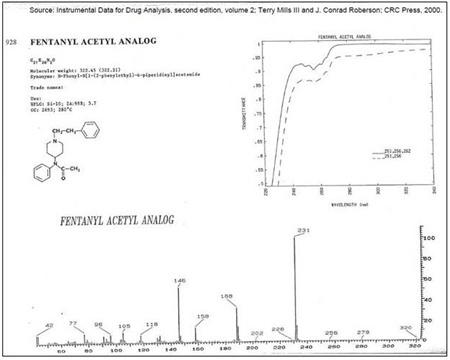
Ions 231, 146, 188 m/z and earlier eluter metabolite/breakdown ANPP 146, 189 m/z
Elution order: Citalopram, ANPP, Paroxetine, ACETYL FENTANYL, Fentanyl, Zolpidem
See chromatographic peak, mass spectrum, and chemical structure of acetyl fentanyl in the exhibit below.
Exhibit:
For more information:
Public health agencies, state laboratories, medical examiners, coroners, and emergency departments should contact CDC if they have seen
any of the following:
- An increase in illicit opioid-related overdose events (morbidity and/or mortality) from January 1, 2013 to present, with or withoutevidence of fentanyl (see case definitions 1 and 2).
- Any individual or clusters of illicit opioid-related overdose events with evidence of acetyl fentanyl or other fentanyl analogconfirmed by GC/MS (see case definition 3).
Please contact one of the following CDC epidemiologists for more information:
- Matthew Lozier, PhD, MPHEmail: mlozier@cdc.gov
Phone: (770) 488-0794
- Colleen Martin, MSPHEmail: CMartin5@cdc.gov
Phone: (770) 488-1468
************************************
You are receiving this email because you are a registered member of the Delaware Health Alert Network. If you are not a member and would
like to subscribe, please register at https://healthalertde.org
===============================================
Categories of Health Alert messages:
- Health Alert: Conveys the highest level of importance; warrants immediate action or attention.
- Health Advisory: Provides important information for a specific incident or situation; may not require immediate action.
- Health Update: Provides updated information regarding an incident or situation; unlikely to require immediate action.


